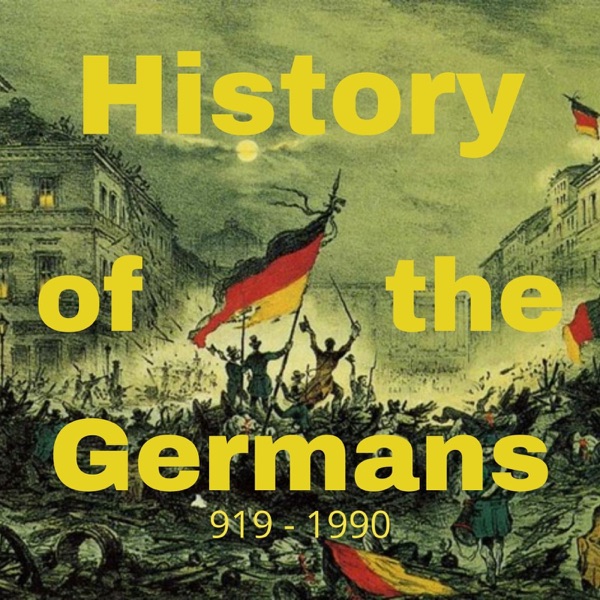
History of the Germans
Dirk Hoffmann-Becking
A narrative history of the German people from the Middle Ages to Reunification in 1991. Episodes are 25-35 min long and drop on Thursday mornings every 2 weeks. "A great many things keep happening, some good, some bad". Gregory of Tours (539-594) So far we have covered: Ottonian Emperors (# 1- 21) - Henry the Fowler (#1) - Otto I (#2-8) - Otto II (#9-11) - Otto II (#11-14) - Henry II (#15-17) - Germany in 1000 (#18-21) Salian Emperors(#22-42) - Konrad II (#22- 25) - Henry III (#26-29) - Henry IV/Canossa (#30-39) - Henry V (#40-42) - Concordat of Worms (#42) Early Hohenstaufen (#43-69) - Lothar III (#43-46) - Konrad III (#47-49) - Frederick Barbarossa (#50-69) Late Hohenstaufen (#70-94) - Henry VI (#70-72) - Philipp of Swabia (#73-74) - Otto IV (#74-75) - Frederick II (#75-90) - Epilogue (#91-94) Colonisation of the East (#95-108) The Hanseatic League (#109-127) The Teutonic Knights (#128-137) From the Interregnum to the Golden Bull (#138 -185) - Rudolf von Habsburg (#139-141) - Adolf von Nassau (#142) - Albrecht von Habsburg (#143) - Heinrich VII (#144-148) - Ludwig the Bavarian (#149-153) - Karl IV (#154-163) The Reformation before the Reformation - Wenceslaus the Lazy (#165) - The Western Schism (#166/167) - The Ottomans (#168) - Sigismund (#169-#184 The Empire in the 15th Century - Mainz & Hessen #186 - Printing #187-#188 - Universities #190 - Wittelsbachs #189, #196-#199 - Baden, Wuerrtemberg, Augsburg, Fugger (#191-195) - Maps & Arms (#201-#202) The Fall and Rise of the House of Habsburg - Early Habsburgs (#203-#207) - Albrecht II (#208) - Friedrich III (#209-#215) - Maximilian I (#215-
A narrative history of the German people from the Middle Ages to Reunification in 1991. Episodes are 25-35 min long and drop on Thursday mornings every 2 weeks. "A great many things keep happening, some good, some bad". Gregory of Tours (539-594) So far we have covered: Ottonian Emperors (# 1- 21) - Henry the Fowler (#1) - Otto I (#2-8) - Otto II (#9-11) - Otto II (#11-14) - Henry II (#15-17) - Germany in 1000 (#18-21) Salian Emperors(#22-42) - Konrad II (#22- 25) - Henry III (#26-29) - Henry IV/Canossa (#30-39) - Henry V (#40-42) - Concordat of Worms (#42) Early Hohenstaufen (#43-69) - Lothar III (#43-46) - Konrad III (#47-49) - Frederick Barbarossa (#50-69) Late Hohenstaufen (#70-94) - Henry VI (#70-72) - Philipp of Swabia (#73-74) - Otto IV (#74-75) - Frederick II (#75-90) - Epilogue (#91-94) Colonisation of the East (#95-108) The Hanseatic League (#109-127) The Teutonic Knights (#128-137) From the Interregnum to the Golden Bull (#138 -185) - Rudolf von Habsburg (#139-141) - Adolf von Nassau (#142) - Albrecht von Habsburg (#143) - Heinrich VII (#144-148) - Ludwig the Bavarian (#149-153) - Karl IV (#154-163) The Reformation before the Reformation - Wenceslaus the Lazy (#165) - The Western Schism (#166/167) - The Ottomans (#168) - Sigismund (#169-#184 The Empire in the 15th Century - Mainz & Hessen #186 - Printing #187-#188 - Universities #190 - Wittelsbachs #189, #196-#199 - Baden, Wuerrtemberg, Augsburg, Fugger (#191-195) - Maps & Arms (#201-#202) The Fall and Rise of the House of Habsburg - Early Habsburgs (#203-#207) - Albrecht II (#208) - Friedrich III (#209-#215) - Maximilian I (#215-
History of the Germans - Trailer
Епизоди
Hello and welcome to the History of the Germans Podcast, the podcast that does exactly what it says on the tin. What you get here is a narrative history of the German people from the early Middle Ages to German Reunification in 1991 in 35-40 minute episodes coming out every Thursday. We are 200 episodes in, but do not worry, you do not need to listen to all 200 for it to make sense. The show is now split into seasons which are almost stand alone. So you can listen to any one of theose and skip the rest. Let me tell you a little bit about these season.... The music for the show is Flute Sonata in E-flat major, H.545 by Carl Phillip Emmanuel Bach (or some claim it as BWV 1031 Johann Sebastian Bach) performed and arranged by Michel Rondeau under Common Creative Licence 3.0. As always: Homepage with maps, photos, transcripts and blog: www.historyofthegermans.com If you wish to support the show go to: Support • History of the Germans Podcast For do it yourself merchandise go to: Merchandise • History of the Germans Podcast Facebook: @HOTGPod Threads: @history_of_the_germans_podcast Bluesky: @hotgpod.bsky.social Instagram: history_of_the_germans Twitter: @germanshistory To make it easier for you to share the podcast, I have created separate playlists for some of the seasons that are set up as individual podcasts. they have the exact same episodes as in the History of the Germans, but they may be a helpful device for those who want to concentrate on only one season. So far I have: The Ottonians Salian Emperors and Investiture Controversy Fredrick Barbarossa and Early Hohenstaufen Frederick II Stupor Mundi Saxony and Eastward Expansion The Hanseatic League The Teutonic Knights The Holy Roman Empire 1250-1356 The Reformation before the Reformation The Empire in the 15th century The Fall and Rise of the Habsburgs ★ Support this podcast ★
Germany was invented by Julius Caesar who also believed Moose had no knees. Herman the German was an officer in the legions, ritual car washing dates back to the 1 century BC and Constantine relied on Frankish soldiers to gain control of the Roman empire. These and other stories about the first 500 years of German(ic) history are part of the Prologue in which I attempt to run through the first 1000 years of German history before 919 AD when the main narrative of the History of the Germans Podcast really starts. The music for the show is Flute Sonata in E-flat major, H.545 by Carl Phillip Emmanuel Bach (or some claim it as BWV 1031 Johann Sebastian Bach) performed and arranged by Michel Rondeau under Common Creative Licence 3.0. As always: Homepage with maps, photos, transcripts and blog: www.historyofthegermans.com Facebook: @HOTGPod Twitter: @germanshistory Instagram: history_of_the_germans Reddit: u/historyofthegermans Patreon: https://www.patreon.com/Historyofthegermans ★ Support this podcast ★
Part 2 of our Prologue to the History of the Germans kicks off with the last western emperor, Romulus Augustulus handing over the insignia of his reign to his German general Odoacer. The next two centuries are dominated by hair-obsessed crime lords, some long-haired gingers, others bearded Lombards. Clovis, first "King of France" and descendant of sea monster, chooses the correct faith to be baptised in. His descendants wade through blood and incest until replaced by Charles "the Hammer" Martel whose son Pippin strikes a bargain with the devil Pope. Again, speed was of the essence so forgive me the occasional simplifications and omissions (Don't be angry Theoderic, we know you were the one good one!) The music for the show is Flute Sonata in E-flat major, H.545 by Carl Phillip Emmanuel Bach (or some claim it as BWV 1031 Johann Sebastian Bach) performed and arranged by Michel Rondeau under Common Creative Licence 3.0. As always: Homepage with maps, photos, transcripts and blog: www.historyofthegermans.com If you wish to support the show go to: Support • History of the Germans Podcast For do it yourself merchandise go to: Merchandise • History of the Germans Podcast Facebook: @HOTGPod Threads: @history_of_the_germans_podcast Bluesky: @hotgpod.bsky.social Instagram: history_of_the_germans Twitter: @germanshistory To make it easier for you to share the podcast, I have created separate playlists for some of the seasons that are set up as individual podcasts. they have the exact same episodes as in the History of the Germans, but they may be a helpful device for those who want to concentrate on only one season. So far I have: The Ottonians Salian Emperors and Investiture Controversy Fredrick Barbarossa and Early Hohenstaufen Frederick II Stupor Mundi Saxony and Eastward Expansion The Hanseatic League The Teutonic Knights The Holy Roman Empire 1250-1356 The Reformation before the Reformation The Empire in the 15th century The Fall and Rise of the Habsburgs ★ Support this podcast ★
Part 3 of the Prologue is dedicated to Charlemagne, one of Europe's greatest rulers. and less because he conquered most of Europe and became the first Roman emperor for 325 years, but because he saved many books from antiquity, increased literacy and numeracy and made it possible for you to read this text comfortably. The music for the show is Flute Sonata in E-flat major, H.545 by Carl Phillip Emmanuel Bach (or some claim it as BWV 1031 Johann Sebastian Bach) performed and arranged by Michel Rondeau under Common Creative Licence 3.0. As always: Homepage with maps, photos, transcripts and blog: www.historyofthegermans.com If you wish to support the show go to: Support • History of the Germans Podcast For do it yourself merchandise go to: Merchandise • History of the Germans Podcast Facebook: @HOTGPod Threads: @history_of_the_germans_podcast Bluesky: @hotgpod.bsky.social Instagram: history_of_the_germans Twitter: @germanshistory To make it easier for you to share the podcast, I have created separate playlists for some of the seasons that are set up as individual podcasts. they have the exact same episodes as in the History of the Germans, but they may be a helpful device for those who want to concentrate on only one season. So far I have: The Ottonians Salian Emperors and Investiture Controversy Fredrick Barbarossa and Early Hohenstaufen Frederick II Stupor Mundi Saxony and Eastward Expansion The Hanseatic League The Teutonic Knights The Holy Roman Empire 1250-1356 The Reformation before the Reformation The Empire in the 15th century The Fall and Rise of the Habsburgs ★ Support this podcast ★
The year is 919 AD and things are not going well. The mighty empire of Charlemagne has splintered into a multitude of puny kingdoms. Its feeble rulers are being pushed around by their formidable barons. The frontiers are breached. In the north the Vikings and Danes are ransacking towns and villages along the coasts and even deep inland. In the east the Slavs are burning Hamburg. And in the south the most terrifying of them all, the Magyars, a steppe tribe like the Huns and the Mongols, are marauding all the way from Bavaria to Northern Spain. Cometh the time, cometh the man/woman? Takeaways: The podcast introduces the tumultuous historical context of East Francia in 919 AD. Henry, Duke of Saxony, was elected king amidst a fractured political landscape. Henry's strategic alliances with other dukes significantly strengthened East Francia's unity. The Holy Lance was obtained by Henry, believed to provide divine support in battles. Henry's military reforms transformed the peasant infantry into a professional fighting force. The victory against the Hungarians in 933 marked a pivotal moment for Henry's reign. Chapters: 00:04 - Introduction to the History of the Germans 00:27 - The Crumbling Kingdoms of 919 AD 04:24 - The Election of Henry the Fowler 06:16 - Unifying the Kingdom: Henry's Strategy 27:07 - The Battle Against the Hungarians 30:42 - Henry's Legacy and Final Reforms 32:23 - Outro and Next Episode Preview The music for the show is Flute Sonata in E-flat major, H.545 by Carl Phillip Emmanuel Bach (or some claim it as BWV 1031 Johann Sebastian Bach) performed and arranged by Michel Rondeau under Common Creative Licence 3.0. As always: Homepage with maps, photos, transcripts and blog: www.historyofthegermans.com If you wish to support the show go to: Support • History of the Germans Podcast For do it yourself merchandise go to: Merchandise • History of the Germans Podcast Facebook: @HOTGPod Threads: @history_of_the_germans_podcast Bluesky: @hotgpod.bsky.social Instagram: history_of_the_germans Twitter: @germanshistory To make it easier for you to share the podcast, I have created separate playlists for some of the seasons that are set up as individual podcasts. they have the exact same episodes as in the History of the Germans, but they may be a helpful device for those who want to concentrate on only one season. So far I have: The Ottonians Salian Emperors and Investiture Controversy Fredrick Barbarossa and Early Hohenstaufen Frederick II Stupor Mundi Saxony and Eastward Expansion The Hanseatic League The Teutonic Knights The Holy Roman Empire 1250-1356 The Reformation before the Reformation The Empire in the 15th century The Fall and Rise of the Habsburgs ★ Support this podcast ★
Henry the Fowler ended the tradition of splitting the kingdom amongst the male heirs. So far, so wise. But, and there is always a but, what he did not work out was what to do with the spares. And there were quite a few spares about, three in total. How will Henry's designated heir, Otto I manage? The music for the show is Flute Sonata in E-flat major, H.545 by Carl Phillip Emmanuel Bach (or some claim it as BWV 1031 Johann Sebastian Bach) performed and arranged by Michel Rondeau under Common Creative Licence 3.0. As always: Homepage with maps, photos, transcripts and blog: www.historyofthegermans.com If you wish to support the show go to: Support • History of the Germans Podcast For do it yourself merchandise go to: Merchandise • History of the Germans Podcast Facebook: @HOTGPod Threads: @history_of_the_germans_podcast Bluesky: @hotgpod.bsky.social Instagram: history_of_the_germans Twitter: @germanshistory To make it easier for you to share the podcast, I have created separate playlists for some of the seasons that are set up as individual podcasts. they have the exact same episodes as in the History of the Germans, but they may be a helpful device for those who want to concentrate on only one season. So far I have: The Ottonians Salian Emperors and Investiture Controversy Fredrick Barbarossa and Early Hohenstaufen Frederick II Stupor Mundi Saxony and Eastward Expansion The Hanseatic League The Teutonic Knights The Holy Roman Empire 1250-1356 The Reformation before the Reformation The Empire in the 15th century The Fall and Rise of the Habsburgs ★ Support this podcast ★
His brother and his biggest vassals are rebelling, the kingdom remains under threat from Hungarians and Slavs - and now the king of France comes in on the side of the opposition. Only a series of very fortunate events can rescue king Otto, or a man of short stature, fierce temper, extraordinary bravery and a dislike of apples and women? The music for the show is Flute Sonata in E-flat major, H.545 by Carl Phillip Emmanuel Bach (or some claim it as BWV 1031 Johann Sebastian Bach) performed and arranged by Michel Rondeau under Common Creative Licence 3.0. As always: Homepage with maps, photos, transcripts and blog: www.historyofthegermans.com If you wish to support the show go to: Support • History of the Germans Podcast For do it yourself merchandise go to: Merchandise • History of the Germans Podcast Facebook: @HOTGPod Threads: @history_of_the_germans_podcast Bluesky: @hotgpod.bsky.social Instagram: history_of_the_germans Twitter: @germanshistory To make it easier for you to share the podcast, I have created separate playlists for some of the seasons that are set up as individual podcasts. they have the exact same episodes as in the History of the Germans, but they may be a helpful device for those who want to concentrate on only one season. So far I have: The Ottonians Salian Emperors and Investiture Controversy Fredrick Barbarossa and Early Hohenstaufen Frederick II Stupor Mundi Saxony and Eastward Expansion The Hanseatic League The Teutonic Knights The Holy Roman Empire 1250-1356 The Reformation before the Reformation The Empire in the 15th century The Fall and Rise of the Habsburgs ★ Support this podcast ★
After the civil war with his brother Henry Otto gets to reorganise the kingdom and focuses on foreign policy. There is conflict on all borders, with the Slavs, the Bohemians, the Hungarians, and the French. Great opportunities for the fine sports of pointless sieges, burning of crops as well massacring peasants. But what do you say to a magnate who offers to swallow seven Saxon lances in one go? The most interesting story plays out in Italy where we find a beautiful young heiress with the key to a kingdom languishing in a jail.... The music for the show is Flute Sonata in E-flat major, H.545 by Carl Phillip Emmanuel Bach (or some claim it as BWV 1031 Johann Sebastian Bach) performed and arranged by Michel Rondeau under Common Creative Licence 3.0. As always: Homepage with maps, photos, transcripts and blog: www.historyofthegermans.com If you wish to support the show go to: Support • History of the Germans Podcast For do it yourself merchandise go to: Merchandise • History of the Germans Podcast Facebook: @HOTGPod Threads: @history_of_the_germans_podcast Bluesky: @hotgpod.bsky.social Instagram: history_of_the_germans Twitter: @germanshistory To make it easier for you to share the podcast, I have created separate playlists for some of the seasons that are set up as individual podcasts. they have the exact same episodes as in the History of the Germans, but they may be a helpful device for those who want to concentrate on only one season. So far I have: The Ottonians Salian Emperors and Investiture Controversy Fredrick Barbarossa and Early Hohenstaufen Frederick II Stupor Mundi Saxony and Eastward Expansion The Hanseatic League The Teutonic Knights The Holy Roman Empire 1250-1356 The Reformation before the Reformation The Empire in the 15th century The Fall and Rise of the Habsburgs ★ Support this podcast ★
Adelheid's rescue creates tension not only in the family of king Otto but across the realm. Younger members of the powerful families feel cheated out of the gains of the Italian campaign and worry about their prospects. And Otto makes again one of these mistakes he is so adept at, resulting in much bloodshed and pain... The music for the show is Flute Sonata in E-flat major, H.545 by Carl Phillip Emmanuel Bach (or some claim it as BWV 1031 Johann Sebastian Bach) performed and arranged by Michel Rondeau under Common Creative Licence 3.0. As always: Homepage with maps, photos, transcripts and blog: www.historyofthegermans.com If you wish to support the show go to: Support • History of the Germans Podcast For do it yourself merchandise go to: Merchandise • History of the Germans Podcast Facebook: @HOTGPod Threads: @history_of_the_germans_podcast Bluesky: @hotgpod.bsky.social Instagram: history_of_the_germans Twitter: @germanshistory To make it easier for you to share the podcast, I have created separate playlists for some of the seasons that are set up as individual podcasts. they have the exact same episodes as in the History of the Germans, but they may be a helpful device for those who want to concentrate on only one season. So far I have: The Ottonians Salian Emperors and Investiture Controversy Fredrick Barbarossa and Early Hohenstaufen Frederick II Stupor Mundi Saxony and Eastward Expansion The Hanseatic League The Teutonic Knights The Holy Roman Empire 1250-1356 The Reformation before the Reformation The Empire in the 15th century The Fall and Rise of the Habsburgs ★ Support this podcast ★
The devastation of the civil war lures in the largest Hungarian army anyone had ever seen anywhere. Enticed by the disinherited sons of former Bavarian dukes, the mighty host makes for Augsburg, a city whose walls are as weak as their defender is steadfast. This time they are here to conquer not just to plunder. Otto has to run hell for leather south gathering an army from wherever he can get his hands on soldiers to face the most amazing military of the times on a battlefield of their choosing..... The music for the show is Flute Sonata in E-flat major, H.545 by Carl Phillip Emmanuel Bach (or some claim it as BWV 1031 Johann Sebastian Bach) performed and arranged by Michel Rondeau under Common Creative Licence 3.0. As always: Homepage with maps, photos, transcripts and blog: www.historyofthegermans.com If you wish to support the show go to: Support • History of the Germans Podcast For do it yourself merchandise go to: Merchandise • History of the Germans Podcast Facebook: @HOTGPod Threads: @history_of_the_germans_podcast Bluesky: @hotgpod.bsky.social Instagram: history_of_the_germans Twitter: @germanshistory To make it easier for you to share the podcast, I have created separate playlists for some of the seasons that are set up as individual podcasts. they have the exact same episodes as in the History of the Germans, but they may be a helpful device for those who want to concentrate on only one season. So far I have: The Ottonians Salian Emperors and Investiture Controversy Fredrick Barbarossa and Early Hohenstaufen Frederick II Stupor Mundi Saxony and Eastward Expansion The Hanseatic League The Teutonic Knights The Holy Roman Empire 1250-1356 The Reformation before the Reformation The Empire in the 15th century The Fall and Rise of the Habsburgs ★ Support this podcast ★
955-963 AD After the battle on the Lechfeld Otto has reached the zenith of his career. All he lacks is the formal recognition of his imperial position within the ancient realm of Charlemagne. For that he has to travel to the malaria-infested swamp that is 10th century Rome where a 23 year old promiscuous and duplicitous pope awaits him... The music for the show is Flute Sonata in E-flat major, H.545 by Carl Phillip Emmanuel Bach (or some claim it as BWV 1031 Johann Sebastian Bach) performed and arranged by Michel Rondeau under Common Creative Licence 3.0. As always: Homepage with maps, photos, transcripts and blog: www.historyofthegermans.com If you wish to support the show go to: Support • History of the Germans Podcast For do it yourself merchandise go to: Merchandise • History of the Germans Podcast Facebook: @HOTGPod Threads: @history_of_the_germans_podcast Bluesky: @hotgpod.bsky.social Instagram: history_of_the_germans Twitter: @germanshistory To make it easier for you to share the podcast, I have created separate playlists for some of the seasons that are set up as individual podcasts. they have the exact same episodes as in the History of the Germans, but they may be a helpful device for those who want to concentrate on only one season. So far I have: The Ottonians Salian Emperors and Investiture Controversy Fredrick Barbarossa and Early Hohenstaufen Frederick II Stupor Mundi Saxony and Eastward Expansion The Hanseatic League The Teutonic Knights The Holy Roman Empire 1250-1356 The Reformation before the Reformation The Empire in the 15th century The Fall and Rise of the Habsburgs ★ Support this podcast ★
Otto's final desire is to be recognised as a fellow emperor by the Basileus in Constantinople. When the Byzantines refuse him the purple-born princess Anna he wages war. The new emperor, John Tzimiskis comes up with a better solution and sends across the most glamorous figure of German medieval history - Theophanu Skleraina... The music for the show is Flute Sonata in E-flat major, H.545 by Carl Phillip Emmanuel Bach (or some claim it as BWV 1031 Johann Sebastian Bach) performed and arranged by Michel Rondeau under Common Creative Licence 3.0. As always: Homepage with maps, photos, transcripts and blog: www.historyofthegermans.com If you wish to support the show go to: Support • History of the Germans Podcast For do it yourself merchandise go to: Merchandise • History of the Germans Podcast Facebook: @HOTGPod Threads: @history_of_the_germans_podcast Bluesky: @hotgpod.bsky.social Instagram: history_of_the_germans Twitter: @germanshistory To make it easier for you to share the podcast, I have created separate playlists for some of the seasons that are set up as individual podcasts. they have the exact same episodes as in the History of the Germans, but they may be a helpful device for those who want to concentrate on only one season. So far I have: The Ottonians Salian Emperors and Investiture Controversy Fredrick Barbarossa and Early Hohenstaufen Frederick II Stupor Mundi Saxony and Eastward Expansion The Hanseatic League The Teutonic Knights The Holy Roman Empire 1250-1356 The Reformation before the Reformation The Empire in the 15th century The Fall and Rise of the Habsburgs ★ Support this podcast ★
When Otto II succeeds his father Otto the Great he inherits a strange construct of interwoven rights, relationships and privileges. He might rely on the church's resources to a degree but to succeed he needs military skill, charisma, proof of the grace of god and luck. With his father being the luckiest man in German history is there any of that elusive substance left for his son... The music for the show is Flute Sonata in E-flat major, H.545 by Carl Phillip Emmanuel Bach (or some claim it as BWV 1031 Johann Sebastian Bach) performed and arranged by Michel Rondeau under Common Creative Licence 3.0. As always: Homepage with maps, photos, transcripts and blog: www.historyofthegermans.com If you wish to support the show go to: Support • History of the Germans Podcast For do it yourself merchandise go to: Merchandise • History of the Germans Podcast Facebook: @HOTGPod Threads: @history_of_the_germans_podcast Bluesky: @hotgpod.bsky.social Instagram: history_of_the_germans Twitter: @germanshistory To make it easier for you to share the podcast, I have created separate playlists for some of the seasons that are set up as individual podcasts. they have the exact same episodes as in the History of the Germans, but they may be a helpful device for those who want to concentrate on only one season. So far I have: The Ottonians Salian Emperors and Investiture Controversy Fredrick Barbarossa and Early Hohenstaufen Frederick II Stupor Mundi Saxony and Eastward Expansion The Hanseatic League The Teutonic Knights The Holy Roman Empire 1250-1356 The Reformation before the Reformation The Empire in the 15th century The Fall and Rise of the Habsburgs ★ Support this podcast ★
Having suppressed the customary early reign rebellion, Otto II makes some poor appointments that result in war with France and estrangement from his mother. Once that has been patched up, he embarks on his major project, incorporating the south of Italy into the empire and thereby bottling up the popes..... The music for the show is Flute Sonata in E-flat major, H.545 by Carl Phillip Emmanuel Bach (or some claim it as BWV 1031 Johann Sebastian Bach) performed and arranged by Michel Rondeau under Common Creative Licence 3.0. As always: Homepage with maps, photos, transcripts and blog: www.historyofthegermans.com If you wish to support the show go to: Support • History of the Germans Podcast For do it yourself merchandise go to: Merchandise • History of the Germans Podcast Facebook: @HOTGPod Threads: @history_of_the_germans_podcast Bluesky: @hotgpod.bsky.social Instagram: history_of_the_germans Twitter: @germanshistory To make it easier for you to share the podcast, I have created separate playlists for some of the seasons that are set up as individual podcasts. they have the exact same episodes as in the History of the Germans, but they may be a helpful device for those who want to concentrate on only one season. So far I have: The Ottonians Salian Emperors and Investiture Controversy Fredrick Barbarossa and Early Hohenstaufen Frederick II Stupor Mundi Saxony and Eastward Expansion The Hanseatic League The Teutonic Knights The Holy Roman Empire 1250-1356 The Reformation before the Reformation The Empire in the 15th century The Fall and Rise of the Habsburgs ★ Support this podcast ★
When 4-year-old king Otto III is crowned king riders bang on the door of Aachen Cathedral with news that his father, Otto II had died 16 days earlier. Immediately the archenemy of the family, Henry the Quarrelsome is released from prison where he was held for treason and is made guardian of the child. Otto III's chance of survival is bleak and his only hope is his mother, the Byzantine princes Theophanu who musters an odd assembly of ladies and geeks to rescue her son... The music for the show is Flute Sonata in E-flat major, H.545 by Carl Phillip Emmanuel Bach (or some claim it as BWV 1031 Johann Sebastian Bach) performed and arranged by Michel Rondeau under Common Creative Licence 3.0. As always: Homepage with maps, photos, transcripts and blog: www.historyofthegermans.com If you wish to support the show go to: Support • History of the Germans Podcast For do it yourself merchandise go to: Merchandise • History of the Germans Podcast Facebook: @HOTGPod Threads: @history_of_the_germans_podcast Bluesky: @hotgpod.bsky.social Instagram: history_of_the_germans Twitter: @germanshistory To make it easier for you to share the podcast, I have created separate playlists for some of the seasons that are set up as individual podcasts. they have the exact same episodes as in the History of the Germans, but they may be a helpful device for those who want to concentrate on only one season. So far I have: The Ottonians Salian Emperors and Investiture Controversy Fredrick Barbarossa and Early Hohenstaufen Frederick II Stupor Mundi Saxony and Eastward Expansion The Hanseatic League The Teutonic Knights The Holy Roman Empire 1250-1356 The Reformation before the Reformation The Empire in the 15th century The Fall and Rise of the Habsburgs ★ Support this podcast ★
Having rescued the reign and possibly life of 4-year-old king Otto III his mother, the byzantine princess Theophanu and later his grandmother Adelheid continue Ottonian policies. This time gives birth to the election of the French dynasty that will rule until 1789 (1830), a length of reign only surpassed by the emperors of Japan. It also witnesses the emergence of Poland as a sovereign nation under the pope. The music for the show is Flute Sonata in E-flat major, H.545 by Carl Phillip Emmanuel Bach (or some claim it as BWV 1031 Johann Sebastian Bach) performed and arranged by Michel Rondeau under Common Creative Licence 3.0. As always: Homepage with maps, photos, transcripts and blog: www.historyofthegermans.com If you wish to support the show go to: Support • History of the Germans Podcast For do it yourself merchandise go to: Merchandise • History of the Germans Podcast Facebook: @HOTGPod Threads: @history_of_the_germans_podcast Bluesky: @hotgpod.bsky.social Instagram: history_of_the_germans Twitter: @germanshistory To make it easier for you to share the podcast, I have created separate playlists for some of the seasons that are set up as individual podcasts. they have the exact same episodes as in the History of the Germans, but they may be a helpful device for those who want to concentrate on only one season. So far I have: The Ottonians Salian Emperors and Investiture Controversy Fredrick Barbarossa and Early Hohenstaufen Frederick II Stupor Mundi Saxony and Eastward Expansion The Hanseatic League The Teutonic Knights The Holy Roman Empire 1250-1356 The Reformation before the Reformation The Empire in the 15th century The Fall and Rise of the Habsburgs ★ Support this podcast ★
Otto III is one of the most controversial emperor in German medieval history. Was he just an uncontrollable teenager with dramatic mood swings? Or did he plan the Restoration of the Empire of the Romans as his propaganda stated? Was he cruel man who executed and mutilated his opponents or was he a deeply spiritual man torn between his piety and the demands of the office? The music for the show is Flute Sonata in E-flat major, H.545 by Carl Phillip Emmanuel Bach (or some claim it as BWV 1031 Johann Sebastian Bach) performed and arranged by Michel Rondeau under Common Creative Licence 3.0. As always: Homepage with maps, photos, transcripts and blog: www.historyofthegermans.com If you wish to support the show go to: Support • History of the Germans Podcast For do it yourself merchandise go to: Merchandise • History of the Germans Podcast Facebook: @HOTGPod Threads: @history_of_the_germans_podcast Bluesky: @hotgpod.bsky.social Instagram: history_of_the_germans Twitter: @germanshistory To make it easier for you to share the podcast, I have created separate playlists for some of the seasons that are set up as individual podcasts. they have the exact same episodes as in the History of the Germans, but they may be a helpful device for those who want to concentrate on only one season. So far I have: The Ottonians Salian Emperors and Investiture Controversy Fredrick Barbarossa and Early Hohenstaufen Frederick II Stupor Mundi Saxony and Eastward Expansion The Hanseatic League The Teutonic Knights The Holy Roman Empire 1250-1356 The Reformation before the Reformation The Empire in the 15th century The Fall and Rise of the Habsburgs ★ Support this podcast ★
After part one of Otto III's "Restoration of the Empire of the Romans" had been a bloody affair, he now embarks on a strenuous display of religious devotion. That includes a trip to Gniezno, the grave of his friend and mentor Saint Adalbert, a trip that has huge consequences for the development of Poland as an independent nation. His excessive ascetism, long periods of prayer and devotion may look incomprehensible to us today, but are they part of an overall concept of a new "Empire of the Romans", one led by an emperor who is both secular and spiritual ruler? And, did it work? The music for the show is Flute Sonata in E-flat major, H.545 by Carl Phillip Emmanuel Bach (or some claim it as BWV 1031 Johann Sebastian Bach) performed and arranged by Michel Rondeau under Common Creative Licence 3.0. As always: Homepage with maps, photos, transcripts and blog: www.historyofthegermans.com If you wish to support the show go to: Support • History of the Germans Podcast For do it yourself merchandise go to: Merchandise • History of the Germans Podcast Facebook: @HOTGPod Threads: @history_of_the_germans_podcast Bluesky: @hotgpod.bsky.social Instagram: history_of_the_germans Twitter: @germanshistory To make it easier for you to share the podcast, I have created separate playlists for some of the seasons that are set up as individual podcasts. they have the exact same episodes as in the History of the Germans, but they may be a helpful device for those who want to concentrate on only one season. So far I have: The Ottonians Salian Emperors and Investiture Controversy Fredrick Barbarossa and Early Hohenstaufen Frederick II Stupor Mundi Saxony and Eastward Expansion The Hanseatic League The Teutonic Knights The Holy Roman Empire 1250-1356 The Reformation before the Reformation The Empire in the 15th century The Fall and Rise of the Habsburgs ★ Support this podcast ★
In this episode we talk about the economy, society, infrastructure and art at the turn of the first millennium. We will look at changes in climate, agriculture, monetary system and warfare. We will take a look at towns and cities, take a deeper dive into Cologne and Magdeburg, muse about the trade in Eunuchs and medieval bathing habits. It is the 10th century when society splits into those who pray (Oratores), those who fight (Bellatores) and those who do all the useful stuff (Laboratores). We discuss the beginnings of castles, 20,000 of which will rise up in Germany during the course of the middle ages...lots to get through! The music for the show is Flute Sonata in E-flat major, H.545 by Carl Phillip Emmanuel Bach (or some claim it as BWV 1031 Johann Sebastian Bach) performed and arranged by Michel Rondeau under Common Creative Licence 3.0. As always: Homepage with maps, photos, transcripts and blog: www.historyofthegermans.com If you wish to support the show go to: Support • History of the Germans Podcast For do it yourself merchandise go to: Merchandise • History of the Germans Podcast Facebook: @HOTGPod Threads: @history_of_the_germans_podcast Bluesky: @hotgpod.bsky.social Instagram: history_of_the_germans Twitter: @germanshistory To make it easier for you to share the podcast, I have created separate playlists for some of the seasons that are set up as individual podcasts. they have the exact same episodes as in the History of the Germans, but they may be a helpful device for those who want to concentrate on only one season. So far I have: The Ottonians Salian Emperors and Investiture Controversy Fredrick Barbarossa and Early Hohenstaufen Frederick II Stupor Mundi Saxony and Eastward Expansion The Hanseatic League The Teutonic Knights The Holy Roman Empire 1250-1356 The Reformation before the Reformation The Empire in the 15th century The Fall and Rise of the Habsburgs ★ Support this podcast ★
This is part 2 of our rundown of the economic and social situation in Germany around the year 1000. The third and highest social strata were the "Oratores", those who pray, the priests, monks and bishops. We look at how a village priest is educated, why monasteries became so rich (spoiler, it is not about piety alone, money is key) and the role of bishops in the Imperial Church System that made the German emperors the most powerful rulers in Western Europe in the 10th and 11th century. How does an emperor rule in the absence of bureaucracy, how much tax matters and why there is no tax in Germany but there is tax in England, why the Normans were more successful in their theocratic leadership approach and how you become emperor....again lots to get through but fun. The music for the show is Flute Sonata in E-flat major, H.545 by Carl Phillip Emmanuel Bach (or some claim it as BWV 1031 Johann Sebastian Bach) performed and arranged by Michel Rondeau under Common Creative Licence 3.0. As always: Homepage with maps, photos, transcripts and blog: www.historyofthegermans.com If you wish to support the show go to: Support • History of the Germans Podcast For do it yourself merchandise go to: Merchandise • History of the Germans Podcast Facebook: @HOTGPod Threads: @history_of_the_germans_podcast Bluesky: @hotgpod.bsky.social Instagram: history_of_the_germans Twitter: @germanshistory To make it easier for you to share the podcast, I have created separate playlists for some of the seasons that are set up as individual podcasts. they have the exact same episodes as in the History of the Germans, but they may be a helpful device for those who want to concentrate on only one season. So far I have: The Ottonians Salian Emperors and Investiture Controversy Fredrick Barbarossa and Early Hohenstaufen Frederick II Stupor Mundi Saxony and Eastward Expansion The Hanseatic League The Teutonic Knights The Holy Roman Empire 1250-1356 The Reformation before the Reformation The Empire in the 15th century The Fall and Rise of the Habsburgs ★ Support this podcast ★
As Otto III's dead body is brought home by his friends, all his dreams and policies collapse behind him. The Emperor had died aged 22 without an heir and he had no brothers or even uncles left. So who should be king? Will it be Hermann of Swabia, from the eternally loyal Konradiner family, Otto of Worms, the dead emperor's closest relative, Count Ekkehard of Meissen, the mighty warrior, Count Ezzo, the nouveau riche husband of Otto III's sister, or Henry of Bavaria, son of a rebel, grandson of a rebel but great-grandson of king Henry the Fowler and therefore the male heir of the dynasty. How do you become emperor? The music for the show is Flute Sonata in E-flat major, H.545 by Carl Phillip Emmanuel Bach (or some claim it as BWV 1031 Johann Sebastian Bach) performed and arranged by Michel Rondeau under Common Creative Licence 3.0. As always: Homepage with maps, photos, transcripts and blog: www.historyofthegermans.com If you wish to support the show go to: Support • History of the Germans Podcast For do it yourself merchandise go to: Merchandise • History of the Germans Podcast Facebook: @HOTGPod Threads: @history_of_the_germans_podcast Bluesky: @hotgpod.bsky.social Instagram: history_of_the_germans Twitter: @germanshistory To make it easier for you to share the podcast, I have created separate playlists for some of the seasons that are set up as individual podcasts. they have the exact same episodes as in the History of the Germans, but they may be a helpful device for those who want to concentrate on only one season. So far I have: The Ottonians Salian Emperors and Investiture Controversy Fredrick Barbarossa and Early Hohenstaufen Frederick II Stupor Mundi Saxony and Eastward Expansion The Hanseatic League The Teutonic Knights The Holy Roman Empire 1250-1356 The Reformation before the Reformation The Empire in the 15th century The Fall and Rise of the Habsburgs ★ Support this podcast ★
1002-1018 AD Once king Henry II has established his rule, he has to face up to a new and increasingly powerful rival. Duke (later King) Boleslav the Brave of Poland has created a large and coherent polity to the east of Germany. When he takes over the counties of Meissen and Lausitz and even Bohemia, war becomes inevitable. Hampered by his own barons being tied to Boleslav by political interest and family ties, Henry II shocks the world by getting into an alliance with the pagan Slavs. In the meantime the Italian nobles have elected one of their own, Arduin of Ivrea to be king, defying Henry's rule. Henry fights his way to Pavia but after the coronation the locals rebel leading to a massacre and the burning down of the capital of the Lombards. The music for the show is Flute Sonata in E-flat major, H.545 by Carl Phillip Emmanuel Bach (or some claim it as BWV 1031 Johann Sebastian Bach) performed and arranged by Michel Rondeau under Common Creative Licence 3.0. As always: Homepage with maps, photos, transcripts and blog: www.historyofthegermans.com If you wish to support the show go to: Support • History of the Germans Podcast For do it yourself merchandise go to: Merchandise • History of the Germans Podcast Facebook: @HOTGPod Threads: @history_of_the_germans_podcast Bluesky: @hotgpod.bsky.social Instagram: history_of_the_germans Twitter: @germanshistory To make it easier for you to share the podcast, I have created separate playlists for some of the seasons that are set up as individual podcasts. they have the exact same episodes as in the History of the Germans, but they may be a helpful device for those who want to concentrate on only one season. So far I have: The Ottonians Salian Emperors and Investiture Controversy Fredrick Barbarossa and Early Hohenstaufen Frederick II Stupor Mundi Saxony and Eastward Expansion The Hanseatic League The Teutonic Knights The Holy Roman Empire 1250-1356 The Reformation before the Reformation The Empire in the 15th century The Fall and Rise of the Habsburgs ★ Support this podcast ★
To understand Henry II you have to start at the end. When he died, he had made no succession plan whatsoever. He was convinced that he had moulded the kingdom into a House of god run by pious monks and observant bishops. If the House of God pleased the lord, he would appoint a new successor, and if not, well the good riddance. Though his policy of strengthening and dominating the church could be looked at as a political ploy to expand the royal prerogative, the more likely truth is that it was only a side effect of Henry's spiritual mission. The actions of early medieval monarchs often appear alien to us, and none more so than Henry II. The music for the show is Flute Sonata in E-flat major, H.545 by Carl Phillip Emmanuel Bach (or some claim it as BWV 1031 Johann Sebastian Bach) performed and arranged by Michel Rondeau under Common Creative Licence 3.0. As always: Homepage with maps, photos, transcripts and blog: www.historyofthegermans.com If you wish to support the show go to: Support • History of the Germans Podcast For do it yourself merchandise go to: Merchandise • History of the Germans Podcast Facebook: @HOTGPod Threads: @history_of_the_germans_podcast Bluesky: @hotgpod.bsky.social Instagram: history_of_the_germans Twitter: @germanshistory To make it easier for you to share the podcast, I have created separate playlists for some of the seasons that are set up as individual podcasts. they have the exact same episodes as in the History of the Germans, but they may be a helpful device for those who want to concentrate on only one season. So far I have: The Ottonians Salian Emperors and Investiture Controversy Fredrick Barbarossa and Early Hohenstaufen Frederick II Stupor Mundi Saxony and Eastward Expansion The Hanseatic League The Teutonic Knights The Holy Roman Empire 1250-1356 The Reformation before the Reformation The Empire in the 15th century The Fall and Rise of the Habsburgs ★ Support this podcast ★
The Ottonian period (919-1024) has been a key reference point in German history ever since. Having only very few and not necessarily very enlightening documents to work from the period became a blank canvas on which historians and the population as a whole projected their own hopes, political beliefs and expectations. In the 19th century the German speaking people who felt humiliated by the defeats against Napoleon and disenfranchised by the political rearranging of their homelands and so latched on to the few unifying historical heroes to refer to - the mighty emperors of the early and high middle ages. Viewing them – depending on political belief – into either mighty rulers of a coherent state who wasted blood, treasure and the whole empire in a fateful entanglement in Italian affairs, or were they benevolent managers of a supranational polity ruling by consent. The falsification of history peaked when the Nazis turned Henry the Fowler into their poster boy. Now, after nearly 200 years of scholarship we aim to see them in the context of their own times, but are we really? The music for the show is Flute Sonata in E-flat major, H.545 by Carl Phillip Emmanuel Bach (or some claim it as BWV 1031 Johann Sebastian Bach) performed and arranged by Michel Rondeau under Common Creative Licence 3.0. As always: Homepage with maps, photos, transcripts and blog: www.historyofthegermans.com If you wish to support the show go to: Support • History of the Germans Podcast For do it yourself merchandise go to: Merchandise • History of the Germans Podcast Facebook: @HOTGPod Threads: @history_of_the_germans_podcast Bluesky: @hotgpod.bsky.social Instagram: history_of_the_germans Twitter: @germanshistory To make it easier for you to share the podcast, I have created separate playlists for some of the seasons that are set up as individual podcasts. they have the exact same episodes as in the History of the Germans, but they may be a helpful device for those who want to concentrate on only one season. So far I have: The Ottonians Salian Emperors and Investiture Controversy Fredrick Barbarossa and Early Hohenstaufen Frederick II Stupor Mundi Saxony and Eastward Expansion The Hanseatic League The Teutonic Knights The Holy Roman Empire 1250-1356 The Reformation before the Reformation The Empire in the 15th century The Fall and Rise of the Habsburgs ★ Support this podcast ★
In this episode I answer your questions about the Podcast in general, specific topics relating to the Ottonian period, languages spoken and German history more broadly. Thank you so much for a really exciting and diverse set of questions. The music for the show is Flute Sonata in E-flat major, H.545 by Carl Phillip Emmanuel Bach (or some claim it as BWV 1031 Johann Sebastian Bach) performed and arranged by Michel Rondeau under Common Creative Licence 3.0. As always: Homepage with maps, photos, transcripts and blog: www.historyofthegermans.com If you wish to support the show go to: Support • History of the Germans Podcast For do it yourself merchandise go to: Merchandise • History of the Germans Podcast Facebook: @HOTGPod Threads: @history_of_the_germans_podcast Bluesky: @hotgpod.bsky.social Instagram: history_of_the_germans Twitter: @germanshistory To make it easier for you to share the podcast, I have created separate playlists for some of the seasons that are set up as individual podcasts. they have the exact same episodes as in the History of the Germans, but they may be a helpful device for those who want to concentrate on only one season. So far I have: The Ottonians Salian Emperors and Investiture Controversy Fredrick Barbarossa and Early Hohenstaufen Frederick II Stupor Mundi Saxony and Eastward Expansion The Hanseatic League The Teutonic Knights The Holy Roman Empire 1250-1356 The Reformation before the Reformation The Empire in the 15th century The Fall and Rise of the Habsburgs ★ Support this podcast ★
On July 13th, 1024 Emperor Henry II died without an heir. not only that, but his family has so comprehensively died out, there is not a single descendant in the male line left. Fear of unrest and civil war grips the inhabitants of the empire. An election is called for early September, as quickly as such things could be organised in the 11th century. The upper echelons of society debate a long list of candidates before agreeing on a shortlist of just two, both named Konrad, both from the same clan of Salian Franks. Medieval imperial elections have little in common with today's elections. there are no set rules about the electors, the purpose is not to determine the will of the people but to unveil the will of God. Decisions are unanimous, mainly because dissenters leave before the votes are cast. Ultimately Konrad the elder (1024-1039) a giant of a man at 2m tall is elected. He appears in all and everything the opposite of his predecessor. But that may be just appearance... The music for the show is Flute Sonata in E-flat major, H.545 by Carl Phillip Emmanuel Bach (or some claim it as BWV 1031 Johann Sebastian Bach) performed and arranged by Michel Rondeau under Common Creative Licence 3.0. As always: Homepage with maps, photos, transcripts and blog: www.historyofthegermans.com If you wish to support the show go to: Support • History of the Germans Podcast For do it yourself merchandise go to: Merchandise • History of the Germans Podcast Facebook: @HOTGPod Threads: @history_of_the_germans_podcast Bluesky: @hotgpod.bsky.social Instagram: history_of_the_germans Twitter: @germanshistory To make it easier for you to share the podcast, I have created separate playlists for some of the seasons that are set up as individual podcasts. they have the exact same episodes as in the History of the Germans, but they may be a helpful device for those who want to concentrate on only one season. So far I have: The Ottonians Salian Emperors and Investiture Controversy Fredrick Barbarossa and Early Hohenstaufen Frederick II Stupor Mundi Saxony and Eastward Expansion The Hanseatic League The Teutonic Knights The Holy Roman Empire 1250-1356 The Reformation before the Reformation The Empire in the 15th century The Fall and Rise of the Habsburgs ★ Support this podcast ★
In this episode Emperor Konrad II (1024-1039) consolidates his reign adding a secular leg to his control of the imperial church by placing his son Henry on the ducal throne of Bavaria,. This is the first of many ducal and royal titles he will acquire. This push for centralised control leads to a rebellion, led by the emperor's 16-year old stepson, duke Ernst II of Swabia (1012-1030). Ernst fights bravely but when his vassals put the oath to the emperor above the fidelity they owe the duke, he has to succumb. Konrad first locks him up but is prepared to reinstate him if he hands over his friend and loyal vassal Werner of Kiburg. When Ernst refuses he becomes an outlaw and - in the legend - has great adventures in weird and foreign lands where the Flat Hoofs and the Grippians live... The music for the show is Flute Sonata in E-flat major, H.545 by Carl Phillip Emmanuel Bach (or some claim it as BWV 1031 Johann Sebastian Bach) performed and arranged by Michel Rondeau under Common Creative Licence 3.0. As always: Homepage with maps, photos, transcripts and blog: www.historyofthegermans.com If you wish to support the show go to: Support • History of the Germans Podcast For do it yourself merchandise go to: Merchandise • History of the Germans Podcast Facebook: @HOTGPod Threads: @history_of_the_germans_podcast Bluesky: @hotgpod.bsky.social Instagram: history_of_the_germans Twitter: @germanshistory To make it easier for you to share the podcast, I have created separate playlists for some of the seasons that are set up as individual podcasts. they have the exact same episodes as in the History of the Germans, but they may be a helpful device for those who want to concentrate on only one season. So far I have: The Ottonians Salian Emperors and Investiture Controversy Fredrick Barbarossa and Early Hohenstaufen Frederick II Stupor Mundi Saxony and Eastward Expansion The Hanseatic League The Teutonic Knights The Holy Roman Empire 1250-1356 The Reformation before the Reformation The Empire in the 15th century The Fall and Rise of the Habsburgs ★ Support this podcast ★
The event looming over Imperial politics since around 1000 is the Burgundian succession. King Rudolf III is childless leaving several contenders with varying degrees of blood relations. If Henry II who was a nephew of Rudolf III had outlived the king of Burgundy, thigs would have been easy. But the old codger outlived the sickly emperor. His successor, Konrad II had no real inheritance right to Burgundy, apart from what came from the tips of spears. Follow the epic fight against Odo of Blois over the ultimately modest riches of the Burgundian Kingdom… The music for the show is Flute Sonata in E-flat major, H.545 by Carl Phillip Emmanuel Bach (or some claim it as BWV 1031 Johann Sebastian Bach) performed and arranged by Michel Rondeau under Common Creative Licence 3.0. As always: Homepage with maps, photos, transcripts and blog: www.historyofthegermans.com If you wish to support the show go to: Support • History of the Germans Podcast For do it yourself merchandise go to: Merchandise • History of the Germans Podcast Facebook: @HOTGPod Threads: @history_of_the_germans_podcast Bluesky: @hotgpod.bsky.social Instagram: history_of_the_germans Twitter: @germanshistory To make it easier for you to share the podcast, I have created separate playlists for some of the seasons that are set up as individual podcasts. they have the exact same episodes as in the History of the Germans, but they may be a helpful device for those who want to concentrate on only one season. So far I have: The Ottonians Salian Emperors and Investiture Controversy Fredrick Barbarossa and Early Hohenstaufen Frederick II Stupor Mundi Saxony and Eastward Expansion The Hanseatic League The Teutonic Knights The Holy Roman Empire 1250-1356 The Reformation before the Reformation The Empire in the 15th century The Fall and Rise of the Habsburgs ★ Support this podcast ★
In his last years Konrad tries to further strengthen his power, first by fighting the Hungarians, unseating the duke of Carinthia and a second Italian expedition. Al three of these endeavours backfire. The Hungarians win the war, the duke of Carinthia gets unexpected support from Konrad's son Henry III and the Italian campaign ends in a fiasco entirely of Konrad's making. Despite these setbacks Konrad leaves a well ordered kingdom when he finally dies in 1039 after 15 years of rule. His kingdom is booming, the creation of Ministeriales and the growth of the cities create opportunities for peasants who find themselves under increasing pressures from their landlords. Castles and churches are being built on an unprecedented scale, culminating in the Cathedral of Speyer, the largest building in Europe at the time (together with the Abbey Church of Cluny) The music for the show is Flute Sonata in E-flat major, H.545 by Carl Phillip Emmanuel Bach (or some claim it as BWV 1031 Johann Sebastian Bach) performed and arranged by Michel Rondeau under Common Creative Licence 3.0. As always: Homepage with maps, photos, transcripts and blog: www.historyofthegermans.com If you wish to support the show go to: Support • History of the Germans Podcast For do it yourself merchandise go to: Merchandise • History of the Germans Podcast Facebook: @HOTGPod Threads: @history_of_the_germans_podcast Bluesky: @hotgpod.bsky.social Instagram: history_of_the_germans Twitter: @germanshistory To make it easier for you to share the podcast, I have created separate playlists for some of the seasons that are set up as individual podcasts. they have the exact same episodes as in the History of the Germans, but they may be a helpful device for those who want to concentrate on only one season. So far I have: The Ottonians Salian Emperors and Investiture Controversy Fredrick Barbarossa and Early Hohenstaufen Frederick II Stupor Mundi Saxony and Eastward Expansion The Hanseatic League The Teutonic Knights The Holy Roman Empire 1250-1356 The Reformation before the Reformation The Empire in the 15th century The Fall and Rise of the Habsburgs ★ Support this podcast ★
For the first time in almost 70 years the transition from one king/emperor to the next is smooth. Konrad II was not only one of the most successful medieval rulers, he also managed to live long enough for his son Henry III to grow up to adulthood before taking over. Henry III is outwardly quite different from his father, well educated, deeply immersed in the concepts of sacred kingship and immensely powerful even before he had become king. But at the same time he shares Konrad's steely determination and aggressive nature. Items 1-3 on his agenda are Poland (a mess), Bohemia (a pseudo-Boleslav) and Hungary (an old grudge). The music for the show is Flute Sonata in E-flat major, H.545 by Carl Phillip Emmanuel Bach (or some claim it as BWV 1031 Johann Sebastian Bach) performed and arranged by Michel Rondeau under Common Creative Licence 3.0. As always: Homepage with maps, photos, transcripts and blog: www.historyofthegermans.com If you wish to support the show go to: Support • History of the Germans Podcast For do it yourself merchandise go to: Merchandise • History of the Germans Podcast Facebook: @HOTGPod Threads: @history_of_the_germans_podcast Bluesky: @hotgpod.bsky.social Instagram: history_of_the_germans Twitter: @germanshistory To make it easier for you to share the podcast, I have created separate playlists for some of the seasons that are set up as individual podcasts. they have the exact same episodes as in the History of the Germans, but they may be a helpful device for those who want to concentrate on only one season. So far I have: The Ottonians Salian Emperors and Investiture Controversy Fredrick Barbarossa and Early Hohenstaufen Frederick II Stupor Mundi Saxony and Eastward Expansion The Hanseatic League The Teutonic Knights The Holy Roman Empire 1250-1356 The Reformation before the Reformation The Empire in the 15th century The Fall and Rise of the Habsburgs ★ Support this podcast ★
The main role of a medieval monarch is to bring peace to his subjects. Peace is not so much absence of major international conflict, but protection from feuding lords. Whilst in France central power is far too weak to maintain any semblance of order giving rise to the Peace of God movement, the empire under Henry III can rely on its monarch to fulfil his role. But his rule is not without tension. The dukes of Saxony and Lothringia are moving into opposition to the king and emperor who falls severely ill in 1045. The music for the show is Flute Sonata in E-flat major, H.545 by Carl Phillip Emmanuel Bach (or some claim it as BWV 1031 Johann Sebastian Bach) performed and arranged by Michel Rondeau under Common Creative Licence 3.0. As always: Homepage with maps, photos, transcripts and blog: www.historyofthegermans.com If you wish to support the show go to: Support • History of the Germans Podcast For do it yourself merchandise go to: Merchandise • History of the Germans Podcast Facebook: @HOTGPod Threads: @history_of_the_germans_podcast Bluesky: @hotgpod.bsky.social Instagram: history_of_the_germans Twitter: @germanshistory To make it easier for you to share the podcast, I have created separate playlists for some of the seasons that are set up as individual podcasts. they have the exact same episodes as in the History of the Germans, but they may be a helpful device for those who want to concentrate on only one season. So far I have: The Ottonians Salian Emperors and Investiture Controversy Fredrick Barbarossa and Early Hohenstaufen Frederick II Stupor Mundi Saxony and Eastward Expansion The Hanseatic League The Teutonic Knights The Holy Roman Empire 1250-1356 The Reformation before the Reformation The Empire in the 15th century The Fall and Rise of the Habsburgs ★ Support this podcast ★
In 1046 Henry III finally has time to go to Rome and claim the imperial crown. All he wants is get in, get crowned and get out before the Malaria season. He encounters a problem when he finds out that the current pope Gregory VI has bought the papacy for cold hard cash, a sin that could invalidate his coronation. Henry III gets involved, deposes all three competing popes and inadvertently starts a chain of events that ends in what Norman Cantor calls "the first of the three world revolutions". The music for the show is Flute Sonata in E-flat major, H.545 by Carl Phillip Emmanuel Bach (or some claim it as BWV 1031 Johann Sebastian Bach) performed and arranged by Michel Rondeau under Common Creative Licence 3.0. As always: Homepage with maps, photos, transcripts and blog: www.historyofthegermans.com If you wish to support the show go to: Support • History of the Germans Podcast For do it yourself merchandise go to: Merchandise • History of the Germans Podcast Facebook: @HOTGPod Threads: @history_of_the_germans_podcast Bluesky: @hotgpod.bsky.social Instagram: history_of_the_germans Twitter: @germanshistory To make it easier for you to share the podcast, I have created separate playlists for some of the seasons that are set up as individual podcasts. they have the exact same episodes as in the History of the Germans, but they may be a helpful device for those who want to concentrate on only one season. So far I have: The Ottonians Salian Emperors and Investiture Controversy Fredrick Barbarossa and Early Hohenstaufen Frederick II Stupor Mundi Saxony and Eastward Expansion The Hanseatic League The Teutonic Knights The Holy Roman Empire 1250-1356 The Reformation before the Reformation The Empire in the 15th century The Fall and Rise of the Habsburgs ★ Support this podcast ★
In 1046 Henry III reached the zenith of his rule. He deposed three unworthy popes and replaced them with serious churchmen who will bring the necessary reforms about. Domestically he is in control of the three Eastern European states, Poland, Bohemia and Hungary and the restless Lotharingians seem settled. How did it come about that by 1056 the chronicler writes that "both the foremost men and the lesser men of the kingdom began more and more to murmur against the emperor. They complained he had long since departed from his original conduct of justice, peace, piety, fear of god and manifold virtues in which he ought to have made progress" The music for the show is Flute Sonata in E-flat major, H.545 by Carl Phillip Emmanuel Bach (or some claim it as BWV 1031 Johann Sebastian Bach) performed and arranged by Michel Rondeau under Common Creative Licence 3.0. As always: Homepage with maps, photos, transcripts and blog: www.historyofthegermans.com If you wish to support the show go to: Support • History of the Germans Podcast For do it yourself merchandise go to: Merchandise • History of the Germans Podcast Facebook: @HOTGPod Threads: @history_of_the_germans_podcast Bluesky: @hotgpod.bsky.social Instagram: history_of_the_germans Twitter: @germanshistory To make it easier for you to share the podcast, I have created separate playlists for some of the seasons that are set up as individual podcasts. they have the exact same episodes as in the History of the Germans, but they may be a helpful device for those who want to concentrate on only one season. So far I have: The Ottonians Salian Emperors and Investiture Controversy Fredrick Barbarossa and Early Hohenstaufen Frederick II Stupor Mundi Saxony and Eastward Expansion The Hanseatic League The Teutonic Knights The Holy Roman Empire 1250-1356 The Reformation before the Reformation The Empire in the 15th century The Fall and Rise of the Habsburgs ★ Support this podcast ★
Emperor Henry III is dead. The realm is now in the hands of his widow, Agnes of Poitou who rules on behalf of the six-year-old king Henry IV. Agnes is no Theophanu and no Adelheid. Not that she is incompetent, she just isn't absolutely brilliant, and absolutely brilliant is the baseline necessary to manage this fragile situation. The relationship between the central imperial power and the magnates has flipped, and instead of all-powerful emperors, the dukes, counts and bishops do what they like. And Henry III's bête noire, Godfrey the Bearded is more powerful than ever. The laity calls for a church that is more like the church of the apostles, pious and dedicated to the poor. They demand an end to simony and the licentiousness of priests. And the papacy asserts its independence. Not that they necessarily intend to throw off the imperial yoke, but the reformers need protectors against the Roman aristocracy that literally used popes as footstools and ATMs. All this culminates in a situation where the young king Henry IV sees no other way to escape from his opponents than by jumping into the cold and fast flowing River Rhine, choosing death over captivity.. The music for the show is Flute Sonata in E-flat major, H.545 by Carl Phillip Emmanuel Bach (or some claim it as BWV 1031 Johann Sebastian Bach) performed and arranged by Michel Rondeau under Common Creative Licence 3.0. As always: Homepage with maps, photos, transcripts and blog: www.historyofthegermans.com If you wish to support the show go to: Support • History of the Germans Podcast For do it yourself merchandise go to: Merchandise • History of the Germans Podcast Facebook: @HOTGPod Threads: @history_of_the_germans_podcast Bluesky: @hotgpod.bsky.social Instagram: history_of_the_germans Twitter: @germanshistory To make it easier for you to share the podcast, I have created separate playlists for some of the seasons that are set up as individual podcasts. they have the exact same episodes as in the History of the Germans, but they may be a helpful device for those who want to concentrate on only one season. So far I have: The Ottonians Salian Emperors and Investiture Controversy Fredrick Barbarossa and Early Hohenstaufen Frederick II Stupor Mundi Saxony and Eastward Expansion The Hanseatic League The Teutonic Knights The Holy Roman Empire 1250-1356 The Reformation before the Reformation The Empire in the 15th century The Fall and Rise of the Habsburgs ★ Support this podcast ★
In 1065 king Henry IV begins his personal rule. After 9 years of regency., the last 3 of which under a government of barons headed by archbishop Anno of Cologne, imperial power is much diminished. Prelates and lords are raiding the imperial purse, when the barons force the young king to dismiss his main adviser, he realises that the previous model of kingship no longer operates. He cannot rely on the oaths of fealty sworn by his counts and dukes, nor can he put faith in the Imperial Church System his predecessors could draw on. He chooses the royal lands around the rich silver mines of Goslar as the nucleus for his new, territorial power base. He builds mighty castles on the tops of mountains that project royal power, he installs a governor, rather than a count as the head of his administration, and most of the castles’ garrison and administrators are ministeriales, unfree men trained in war. This new policy clashes with the Saxons, the stem who had already stood in opposition to Henry's father and had plotted to murder him when he was only a child. In 1073 the Saxons gather in an assembly to hear Otto of Northeim 's famous speech that turned disaffection into outright rebellion. In 18 months, Henry IV's Saxon War will become a rollercoaster where he goes from unconditional surrender to triumph - but is the triumph going to last? The music for the show is Flute Sonata in E-flat major, H.545 by Carl Phillip Emmanuel Bach (or some claim it as BWV 1031 Johann Sebastian Bach) performed and arranged by Michel Rondeau under Common Creative Licence 3.0. As always: Homepage with maps, photos, transcripts and blog: www.historyofthegermans.com If you wish to support the show go to: Support • History of the Germans Podcast For do it yourself merchandise go to: Merchandise • History of the Germans Podcast Facebook: @HOTGPod Threads: @history_of_the_germans_podcast Bluesky: @hotgpod.bsky.social Instagram: history_of_the_germans Twitter: @germanshistory To make it easier for you to share the podcast, I have created separate playlists for some of the seasons that are set up as individual podcasts. they have the exact same episodes as in the History of the Germans, but they may be a helpful device for those who want to concentrate on only one season. So far I have: The Ottonians Salian Emperors and Investiture Controversy Fredrick Barbarossa and Early Hohenstaufen Frederick II Stupor Mundi Saxony and Eastward Expansion The Hanseatic League The Teutonic Knights The Holy Roman Empire 1250-1356 The Reformation before the Reformation The Empire in the 15th century The Fall and Rise of the Habsburgs ★ Support this podcast ★
The rise of the papacy since 1046 is almost linear. The popes throw off the chokehold of the roman aristocracy, they take over leadership of the church reform movement from the emperors, and by the end of the pontificate of Alexander II the Holy See has become universal with kings hailing the pope and not the emperor as their overlord. In 1073 Hildebrand, the eminence grise of the last 20 years ascends the throne of St. Peter. His view of the role of the papacy goes even further than his predecessors. We know this because he laid it out in one of the most remarkable documents of the middle ages, the Dictatus Papae. This ever expanding role of the papacy had to collide at some point with the other universal power, the emperor Henry IV. Letters are exchanged and words are spoken that set events in motion that will destroy them both. The music for the show is Flute Sonata in E-flat major, H.545 by Carl Phillip Emmanuel Bach (or some claim it as BWV 1031 Johann Sebastian Bach) performed and arranged by Michel Rondeau under Common Creative Licence 3.0. As always: Homepage with maps, photos, transcripts and blog: www.historyofthegermans.com If you wish to support the show go to: Support • History of the Germans Podcast For do it yourself merchandise go to: Merchandise • History of the Germans Podcast Facebook: @HOTGPod Threads: @history_of_the_germans_podcast Bluesky: @hotgpod.bsky.social Instagram: history_of_the_germans Twitter: @germanshistory To make it easier for you to share the podcast, I have created separate playlists for some of the seasons that are set up as individual podcasts. they have the exact same episodes as in the History of the Germans, but they may be a helpful device for those who want to concentrate on only one season. So far I have: The Ottonians Salian Emperors and Investiture Controversy Fredrick Barbarossa and Early Hohenstaufen Frederick II Stupor Mundi Saxony and Eastward Expansion The Hanseatic League The Teutonic Knights The Holy Roman Empire 1250-1356 The Reformation before the Reformation The Empire in the 15th century The Fall and Rise of the Habsburgs ★ Support this podcast ★
It is time - we are finally going to Canossa. Expect imperial power to disappear in smoke, greedy mothers-in-laws, frozen passes, hoisted horses and tobogganing empresses. All that ends with the enduring picture of a king first kneeling before a woman and then before a pope..... That is the the episode you have to listen to! The music for the show is Flute Sonata in E-flat major, H.545 by Carl Phillip Emmanuel Bach (or some claim it as BWV 1031 Johann Sebastian Bach) performed and arranged by Michel Rondeau under Common Creative Licence 3.0. As always: Homepage with maps, photos, transcripts and blog: www.historyofthegermans.com If you wish to support the show go to: Support • History of the Germans Podcast For do it yourself merchandise go to: Merchandise • History of the Germans Podcast Facebook: @HOTGPod Threads: @history_of_the_germans_podcast Bluesky: @hotgpod.bsky.social Instagram: history_of_the_germans Twitter: @germanshistory To make it easier for you to share the podcast, I have created separate playlists for some of the seasons that are set up as individual podcasts. they have the exact same episodes as in the History of the Germans, but they may be a helpful device for those who want to concentrate on only one season. So far I have: The Ottonians Salian Emperors and Investiture Controversy Fredrick Barbarossa and Early Hohenstaufen Frederick II Stupor Mundi Saxony and Eastward Expansion The Hanseatic League The Teutonic Knights The Holy Roman Empire 1250-1356 The Reformation before the Reformation The Empire in the 15th century The Fall and Rise of the Habsburgs ★ Support this podcast ★
Henry IV departs from Canossa having been released from the ban. But does that mean all his troubles are over? Far from it. His enemies in Germany gather to elect a new king and the war of words turns into a war of swords. The music for the show is Flute Sonata in E-flat major, H.545 by Carl Phillip Emmanuel Bach (or some claim it as BWV 1031 Johann Sebastian Bach) performed and arranged by Michel Rondeau under Common Creative Licence 3.0. As always: Homepage with maps, photos, transcripts and blog: www.historyofthegermans.com If you wish to support the show go to: Support • History of the Germans Podcast For do it yourself merchandise go to: Merchandise • History of the Germans Podcast Facebook: @HOTGPod Threads: @history_of_the_germans_podcast Bluesky: @hotgpod.bsky.social Instagram: history_of_the_germans Twitter: @germanshistory To make it easier for you to share the podcast, I have created separate playlists for some of the seasons that are set up as individual podcasts. they have the exact same episodes as in the History of the Germans, but they may be a helpful device for those who want to concentrate on only one season. So far I have: The Ottonians Salian Emperors and Investiture Controversy Fredrick Barbarossa and Early Hohenstaufen Frederick II Stupor Mundi Saxony and Eastward Expansion The Hanseatic League The Teutonic Knights The Holy Roman Empire 1250-1356 The Reformation before the Reformation The Empire in the 15th century The Fall and Rise of the Habsburgs ★ Support this podcast ★
The Rebellion in Germany under control Henry can finally go after his true nemesis, Pope Gregory VII. He sets out for Rome on a journey he thought may just take four months but ended up taking four years.. The music for the show is Flute Sonata in E-flat major, H.545 by Carl Phillip Emmanuel Bach (or some claim it as BWV 1031 Johann Sebastian Bach) performed and arranged by Michel Rondeau under Common Creative Licence 3.0. As always: Homepage with maps, photos, transcripts and blog: www.historyofthegermans.com If you wish to support the show go to: Support • History of the Germans Podcast For do it yourself merchandise go to: Merchandise • History of the Germans Podcast Facebook: @HOTGPod Threads: @history_of_the_germans_podcast Bluesky: @hotgpod.bsky.social Instagram: history_of_the_germans Twitter: @germanshistory To make it easier for you to share the podcast, I have created separate playlists for some of the seasons that are set up as individual podcasts. they have the exact same episodes as in the History of the Germans, but they may be a helpful device for those who want to concentrate on only one season. So far I have: The Ottonians Salian Emperors and Investiture Controversy Fredrick Barbarossa and Early Hohenstaufen Frederick II Stupor Mundi Saxony and Eastward Expansion The Hanseatic League The Teutonic Knights The Holy Roman Empire 1250-1356 The Reformation before the Reformation The Empire in the 15th century The Fall and Rise of the Habsburgs ★ Support this podcast ★
His coronation barely two months hence, Henry IV leaves Rome without capturing Gregory VII. The Pope's powerful vassal, Robert Guiscard, Duke of Apulia and greatest of Norman warlords was approaching with an army of 36,000. Henry no longer needs Rome, what he needs to do is get back to Germany and bring peace to the war-ravaged country. A u-turn in his policies helps to gain support amongst bishops and magnates so that by 1089, the country is largely pacified for the first time in 17 years. The music for the show is Flute Sonata in E-flat major, H.545 by Carl Phillip Emmanuel Bach (or some claim it as BWV 1031 Johann Sebastian Bach) performed and arranged by Michel Rondeau under Common Creative Licence 3.0. As always: Homepage with maps, photos, transcripts and blog: www.historyofthegermans.com If you wish to support the show go to: Support • History of the Germans Podcast For do it yourself merchandise go to: Merchandise • History of the Germans Podcast Facebook: @HOTGPod Threads: @history_of_the_germans_podcast Bluesky: @hotgpod.bsky.social Instagram: history_of_the_germans Twitter: @germanshistory To make it easier for you to share the podcast, I have created separate playlists for some of the seasons that are set up as individual podcasts. they have the exact same episodes as in the History of the Germans, but they may be a helpful device for those who want to concentrate on only one season. So far I have: The Ottonians Salian Emperors and Investiture Controversy Fredrick Barbarossa and Early Hohenstaufen Frederick II Stupor Mundi Saxony and Eastward Expansion The Hanseatic League The Teutonic Knights The Holy Roman Empire 1250-1356 The Reformation before the Reformation The Empire in the 15th century The Fall and Rise of the Habsburgs ★ Support this podcast ★
The wheel of fortune turns again, tumbling our antihero Henry IV down from the heights he had so recently scaled. We will see him sink to the point of utter despair. And all that because a 43 year old woman marries an 18 year old. The music for the show is Flute Sonata in E-flat major, H.545 by Carl Phillip Emmanuel Bach (or some claim it as BWV 1031 Johann Sebastian Bach) performed and arranged by Michel Rondeau under Common Creative Licence 3.0. As always: Homepage with maps, photos, transcripts and blog: www.historyofthegermans.com If you wish to support the show go to: Support • History of the Germans Podcast For do it yourself merchandise go to: Merchandise • History of the Germans Podcast Facebook: @HOTGPod Threads: @history_of_the_germans_podcast Bluesky: @hotgpod.bsky.social Instagram: history_of_the_germans Twitter: @germanshistory To make it easier for you to share the podcast, I have created separate playlists for some of the seasons that are set up as individual podcasts. they have the exact same episodes as in the History of the Germans, but they may be a helpful device for those who want to concentrate on only one season. So far I have: The Ottonians Salian Emperors and Investiture Controversy Fredrick Barbarossa and Early Hohenstaufen Frederick II Stupor Mundi Saxony and Eastward Expansion The Hanseatic League The Teutonic Knights The Holy Roman Empire 1250-1356 The Reformation before the Reformation The Empire in the 15th century The Fall and Rise of the Habsburgs ★ Support this podcast ★
In 1095 Pope Urban II launches the First crusade. Emperor Henry IV and his allies would rather be strung up below a beehive covered in honey than join a scheme devised by the Gregorian Pope. The lack of support by the high aristocrats did not stop the common people most of whom perish before the crusade had really begun. And some turn their religious fervour into a very different endeavour, bringing untold pain to the Jewish communities in Germany.. The music for the show is Flute Sonata in E-flat major, H.545 by Carl Phillip Emmanuel Bach (or some claim it as BWV 1031 Johann Sebastian Bach) performed and arranged by Michel Rondeau under Common Creative Licence 3.0. As always: Homepage with maps, photos, transcripts and blog: www.historyofthegermans.com If you wish to support the show go to: Support • History of the Germans Podcast For do it yourself merchandise go to: Merchandise • History of the Germans Podcast Facebook: @HOTGPod Threads: @history_of_the_germans_podcast Bluesky: @hotgpod.bsky.social Instagram: history_of_the_germans Twitter: @germanshistory To make it easier for you to share the podcast, I have created separate playlists for some of the seasons that are set up as individual podcasts. they have the exact same episodes as in the History of the Germans, but they may be a helpful device for those who want to concentrate on only one season. So far I have: The Ottonians Salian Emperors and Investiture Controversy Fredrick Barbarossa and Early Hohenstaufen Frederick II Stupor Mundi Saxony and Eastward Expansion The Hanseatic League The Teutonic Knights The Holy Roman Empire 1250-1356 The Reformation before the Reformation The Empire in the 15th century The Fall and Rise of the Habsburgs ★ Support this podcast ★
This week we will talk about the last years of Henry IV, which, as hard as it is to believe, holds a final humiliation that capped the pain this man had already endured. The music for the show is Flute Sonata in E-flat major, H.545 by Carl Phillip Emmanuel Bach (or some claim it as BWV 1031 Johann Sebastian Bach) performed and arranged by Michel Rondeau under Common Creative Licence 3.0. As always: Homepage with maps, photos, transcripts and blog: www.historyofthegermans.com If you wish to support the show go to: Support • History of the Germans Podcast For do it yourself merchandise go to: Merchandise • History of the Germans Podcast Facebook: @HOTGPod Threads: @history_of_the_germans_podcast Bluesky: @hotgpod.bsky.social Instagram: history_of_the_germans Twitter: @germanshistory To make it easier for you to share the podcast, I have created separate playlists for some of the seasons that are set up as individual podcasts. they have the exact same episodes as in the History of the Germans, but they may be a helpful device for those who want to concentrate on only one season. So far I have: The Ottonians Salian Emperors and Investiture Controversy Fredrick Barbarossa and Early Hohenstaufen Frederick II Stupor Mundi Saxony and Eastward Expansion The Hanseatic League The Teutonic Knights The Holy Roman Empire 1250-1356 The Reformation before the Reformation The Empire in the 15th century The Fall and Rise of the Habsburgs ★ Support this podcast ★
In this episode we will see whether young Henry V will do any better at ending the conflict between Pope and Emperor, featuring one of the most audacious political moves seen in this conflict. The music for the show is Flute Sonata in E-flat major, H.545 by Carl Phillip Emmanuel Bach (or some claim it as BWV 1031 Johann Sebastian Bach) performed and arranged by Michel Rondeau under Common Creative Licence 3.0. As always: Homepage with maps, photos, transcripts and blog: www.historyofthegermans.com If you wish to support the show go to: Support • History of the Germans Podcast For do it yourself merchandise go to: Merchandise • History of the Germans Podcast Facebook: @HOTGPod Threads: @history_of_the_germans_podcast Bluesky: @hotgpod.bsky.social Instagram: history_of_the_germans Twitter: @germanshistory To make it easier for you to share the podcast, I have created separate playlists for some of the seasons that are set up as individual podcasts. they have the exact same episodes as in the History of the Germans, but they may be a helpful device for those who want to concentrate on only one season. So far I have: The Ottonians Salian Emperors and Investiture Controversy Fredrick Barbarossa and Early Hohenstaufen Frederick II Stupor Mundi Saxony and Eastward Expansion The Hanseatic League The Teutonic Knights The Holy Roman Empire 1250-1356 The Reformation before the Reformation The Empire in the 15th century The Fall and Rise of the Habsburgs ★ Support this podcast ★
In this week’s episode the last of the Salians will find that despite all his efforts, the tide of history cannot be stemmed, almost leaving him in exactly the same place his father ended up in 1076. The music for the show is Flute Sonata in E-flat major, H.545 by Carl Phillip Emmanuel Bach (or some claim it as BWV 1031 Johann Sebastian Bach) performed and arranged by Michel Rondeau under Common Creative Licence 3.0. As always: Homepage with maps, photos, transcripts and blog: www.historyofthegermans.com If you wish to support the show go to: Support • History of the Germans Podcast For do it yourself merchandise go to: Merchandise • History of the Germans Podcast Facebook: @HOTGPod Threads: @history_of_the_germans_podcast Bluesky: @hotgpod.bsky.social Instagram: history_of_the_germans Twitter: @germanshistory To make it easier for you to share the podcast, I have created separate playlists for some of the seasons that are set up as individual podcasts. they have the exact same episodes as in the History of the Germans, but they may be a helpful device for those who want to concentrate on only one season. So far I have: The Ottonians Salian Emperors and Investiture Controversy Fredrick Barbarossa and Early Hohenstaufen Frederick II Stupor Mundi Saxony and Eastward Expansion The Hanseatic League The Teutonic Knights The Holy Roman Empire 1250-1356 The Reformation before the Reformation The Empire in the 15th century The Fall and Rise of the Habsburgs ★ Support this podcast ★
In this episode we will come to the end of the Investiture controversy, the end of the Salian dynasty and the end of Season 2 – and ask the question, what was all that about? The music for the show is Flute Sonata in E-flat major, H.545 by Carl Phillip Emmanuel Bach (or some claim it as BWV 1031 Johann Sebastian Bach) performed and arranged by Michel Rondeau under Common Creative Licence 3.0. As always: Homepage with maps, photos, transcripts and blog: www.historyofthegermans.com If you wish to support the show go to: Support • History of the Germans Podcast For do it yourself merchandise go to: Merchandise • History of the Germans Podcast Facebook: @HOTGPod Threads: @history_of_the_germans_podcast Bluesky: @hotgpod.bsky.social Instagram: history_of_the_germans Twitter: @germanshistory To make it easier for you to share the podcast, I have created separate playlists for some of the seasons that are set up as individual podcasts. they have the exact same episodes as in the History of the Germans, but they may be a helpful device for those who want to concentrate on only one season. So far I have: The Ottonians Salian Emperors and Investiture Controversy Fredrick Barbarossa and Early Hohenstaufen Frederick II Stupor Mundi Saxony and Eastward Expansion The Hanseatic League The Teutonic Knights The Holy Roman Empire 1250-1356 The Reformation before the Reformation The Empire in the 15th century The Fall and Rise of the Habsburgs ★ Support this podcast ★
Welcome to Season 3 of the History of the Germans, diving into one of the most dramatic and consequential periods of medieval German history — the age of the Hohenstaufen. But before the Hohenstaufen can take centre stage, someone else has to get out of the way first. It is 1125, and the Salian dynasty is dying with Emperor Henry V in the palace of the Bishop of Utrecht. After a century of Salian rule — marked by civil war, the Investiture Controversy, and a catastrophic weakening of imperial authority — the princes of the realm face a fundamental question: what is an emperor actually for? In this episode, we set the scene for the next great chapter of German medieval history by exploring the three strategies available to any new emperor seeking to rebuild royal power, and then watch as those strategies are tested almost immediately — at one of the most chaotic and dramatic royal elections the Holy Roman Empire ever produced. At Mainz in August 1125, four great dynasties — the Hohenstaufen, the Welf, the Babenberg, and the Supplinburg — converge to elect a new king. What follows is a masterclass in medieval political theatre: tearful refusals, procedural confusion, a man jumping on a horse at entirely the wrong moment, and a last-minute betrayal that will echo through German and Italian politics for the next 150 years. Topics covered in this episode: The collapse of Salian imperial authority and the legacy of the Investiture Controversy The three strategic options facing any new Holy Roman Emperor The key players at the election of 1125: Lothar of Supplinburg, Frederick of Hohenstaufen, Henry the Black of Bavaria, and Leopold of Austria Why not wanting the crown was the surest way to win it The Welf betrayal that ignited the Guelf vs Ghibelline conflict across medieval Europe The election of Lothar III — and why the age of the Hohenstaufen paradoxically begins without one Keywords: Holy Roman Empire, Hohenstaufen, Salian dynasty, Lothar III, medieval German history, Welf dynasty, Guelph Ghibelline, election 1125, Frederick of Hohenstaufen, History of the Germans podcast, medieval Europe, Investiture Controversy, House of Babenberg The music for the show is Flute Sonata in E-flat major, H.545 by Carl Phillip Emmanuel Bach (or some claim it as BWV 1031 Johann Sebastian Bach) performed and arranged by Michel Rondeau under Common Creative Licence 3.0. As always: Homepage with maps, photos, transcripts and blog: www.historyofthegermans.com If you wish to support the show go to: Support • History of the Germans Podcast For do it yourself merchandise go to: Merchandise • History of the Germans Podcast Facebook: @HOTGPod Threads: @history_of_the_germans_podcast Bluesky: @hotgpod.bsky.social Instagram: history_of_the_germans Twitter: @germanshistory To make it easier for you to share the podcast, I have created separate playlists for some of the seasons that are set up as individual podcasts. they have the exact same episodes as in the History of the Germans, but they may be a helpful device for those who want to concentrate on only one season. So far I have: The Ottonians Salian Emperors and Investiture Controversy Fredrick Barbarossa and Early Hohenstaufen Frederick II Stupor Mundi Saxony and Eastward Expansion The Hanseatic League The Teutonic Knights The Holy Roman Empire 1250-1356 The Reformation before the Reformation The Empire in the 15th century The Fall and Rise of the Habsburgs ★ Support this podcast ★
The election of Lothar III in 1125 was a humiliation for the House of Hohenstaufen — nephews of the last emperor, passed over in favour of their greatest rival. But Frederick and Konrad of Hohenstaufen are not the type to quietly accept defeat. What follows is nearly a decade of civil war, a daring Italian adventure, and one of the most ambitious power grabs in medieval German history. In this episode, we follow the turbulent early reign of Lothar III as he struggles to assert royal authority over a realm fractured by 50 years of civil war. His problems begin almost immediately — a failed military campaign in Bohemia, a bruising dispute over the archbishopric of Magdeburg, and the near-impossible task of reclaiming the Salian crown lands now firmly in Hohenstaufen hands. Meanwhile, the brothers Frederick and Konrad launch a full-scale rebellion. They elect an anti-king, hold Germany's first recorded tournament outside the walls of Würzburg, and — in a bold strategic gamble — take the fight to Italy, where Konrad is crowned king of Italy by the Archbishop of Milan and marches on Rome in a bid to outrank Lothar altogether. We also look at one of the most consequential but least celebrated developments of this period: the beginning of the great eastward expansion of German settlement beyond the Elbe — the policy that would eventually give rise to Brandenburg, Prussia, and reshape the ethnic map of central Europe for centuries. Topics covered in this episode: Lothar III's difficult early reign and his struggles with the Hohenstaufen inheritance dispute The Hohenstaufen civil war: sieges, tournaments, and the election of an anti-king Konrad of Hohenstaufen's Italian campaign and his coronation as king of Italy in Milan The Welf alliance and how Henry the Proud became the most powerful lord in Germany Lothar's policy of eastern colonisation and the origins of the Margraviate of Brandenburg The final submission of the Hohenstaufen brothers in 1134 Keywords: Holy Roman Empire, Hohenstaufen, Lothar III, medieval German history, Konrad of Hohenstaufen, Frederick of Swabia, Welf dynasty, eastern colonisation, Ostsiedlung, Brandenburg, History of the Germans podcast, medieval civil war, king of Italy, anti-king The music for the show is Flute Sonata in E-flat major, H.545 by Carl Phillip Emmanuel Bach (or some claim it as BWV 1031 Johann Sebastian Bach) performed and arranged by Michel Rondeau under Common Creative Licence 3.0. As always: Homepage with maps, photos, transcripts and blog: www.historyofthegermans.com If you wish to support the show go to: Support • History of the Germans Podcast For do it yourself merchandise go to: Merchandise • History of the Germans Podcast Facebook: @HOTGPod Threads: @history_of_the_germans_podcast Bluesky: @hotgpod.bsky.social Instagram: history_of_the_germans Twitter: @germanshistory To make it easier for you to share the podcast, I have created separate playlists for some of the seasons that are set up as individual podcasts. they have the exact same episodes as in the History of the Germans, but they may be a helpful device for those who want to concentrate on only one season. So far I have: The Ottonians Salian Emperors and Investiture Controversy Fredrick Barbarossa and Early Hohenstaufen Frederick II Stupor Mundi Saxony and Eastward Expansion The Hanseatic League The Teutonic Knights The Holy Roman Empire 1250-1356 The Reformation before the Reformation The Empire in the 15th century The Fall and Rise of the Habsburgs ★ Support this podcast ★
Before Lothar III can claim the imperial crown, he needs a pope to give it to him. There's just one problem — in 1130, Rome has two of them. In this episode we take a vital detour to the eternal city, where medieval papal politics are every bit as violent, corrupt, and compelling as anything happening north of the Alps. Murder, torture, family vendettas, a pope dragged through the streets by his hair — and that's before the schism even begins. We trace the bitter rivalry between Rome's two great dynastic clans, the Frangipani and the Pierleoni, whose struggle for control of the papacy has been simmering for decades. We meet the remarkable Pope Honorius II — a peasant's son who rose to become one of the most respected men in Christendom — and ask how his death in 1130 is about to blow the lid off every tension in the medieval church simultaneously. But this episode is also about something much bigger than Roman clan politics. It's about a church splitting three ways at once — between old-school Gregorian reformers and the new austerity of the Cistercians, and between the soaring mysticism of Bernard of Clairvaux and the razor-sharp logic of Peter Abelard, the most controversial theologian of the age. Along the way we cover the origins of Limbo, a medieval monk's digestive catastrophe, the most explicit sermon ever preached on the Song of Solomon, and the story of Heloise and Abelard — one of the great love affairs of the Middle Ages, ending in castration and a life in the cloister. But the real head of the church is an abbot from Burgundy, Bernard of Clairvaux who is longing for an ecstatic union with the heavenly bridegroom - hence the picture (Gian Lorenzo Bernini, the Ecstasy of Santa Teresa, 1647-1654) Topics covered in this episode: The Frangipani and Pierleoni clans and their violent grip on the medieval papacy How the Gregorian reform transformed — and alienated — Rome's aristocracy The rise of the Cistercian order and the extraordinary influence of Bernard of Clairvaux Peter Abelard, scholasticism, and the birth of logical theology The love story of Abelard and Heloise — and its brutal ending The looming papal schism of 1130 and the impossible choice it poses for Lothar III Keywords: medieval papacy, papal schism 1130, Bernard of Clairvaux, Peter Abelard, Cistercian order, Frangipani, Pierleoni, Lothar III, Holy Roman Empire, scholasticism, medieval church history, Heloise and Abelard, History of the Germans podcast, Gregorian reform, medieval Rome The music for the show is Flute Sonata in E-flat major, H.545 by Carl Phillip Emmanuel Bach (or some claim it as BWV 1031 Johann Sebastian Bach) performed and arranged by Michel Rondeau under Common Creative Licence 3.0. As always: Homepage with maps, photos, transcripts and blog: www.historyofthegermans.com If you wish to support the show go to: Support • History of the Germans Podcast For do it yourself merchandise go to: Merchandise • History of the Germans Podcast Facebook: @HOTGPod Threads: @history_of_the_germans_podcast Bluesky: @hotgpod.bsky.social Instagram: history_of_the_germans Twitter: @germanshistory To make it easier for you to share the podcast, I have created separate playlists for some of the seasons that are set up as individual podcasts. they have the exact same episodes as in the History of the Germans, but they may be a helpful device for those who want to concentrate on only one season. So far I have: The Ottonians Salian Emperors and Investiture Controversy Fredrick Barbarossa and Early Hohenstaufen Frederick II Stupor Mundi Saxony and Eastward Expansion The Hanseatic League The Teutonic Knights The Holy Roman Empire 1250-1356 The Reformation before the Reformation The Empire in the 15th century The Fall and Rise of the Habsburgs ★ Support this podcast ★
1130-1137 - Emperor Lothar III is getting embroiled in the schism between popes Innocent II and Anaclet II. Anaclet II is properly elected and holds Rome whilst Innocent II enjoys the support of the most influential church leader of the time, St. Bernard of Clairvaux. Fear of St. Bernard drives Lothar into the camp of Innocent II which means he has to go down to Italy and conquer Rome for the Pope. Not only that but it also means a conflict with Roger II by now king of Sicily and master of a large Norman /Saracen army. And hat is in it for him? A rewriting of the Concordat of Worms? Ownership of the lands of the great countess Matilda? or something entirely different? The music for the show is Flute Sonata in E-flat major, H.545 by Carl Phillip Emmanuel Bach (or some claim it as BWV 1031 Johann Sebastian Bach) performed and arranged by Michel Rondeau under Common Creative Licence 3.0. As always: Homepage with maps, photos, transcripts and blog: www.historyofthegermans.com If you wish to support the show go to: Support • History of the Germans Podcast For do it yourself merchandise go to: Merchandise • History of the Germans Podcast Facebook: @HOTGPod Threads: @history_of_the_germans_podcast Bluesky: @hotgpod.bsky.social Instagram: history_of_the_germans Twitter: @germanshistory To make it easier for you to share the podcast, I have created separate playlists for some of the seasons that are set up as individual podcasts. they have the exact same episodes as in the History of the Germans, but they may be a helpful device for those who want to concentrate on only one season. So far I have: The Ottonians Salian Emperors and Investiture Controversy Fredrick Barbarossa and Early Hohenstaufen Frederick II Stupor Mundi Saxony and Eastward Expansion The Hanseatic League The Teutonic Knights The Holy Roman Empire 1250-1356 The Reformation before the Reformation The Empire in the 15th century The Fall and Rise of the Habsburgs ★ Support this podcast ★